What the Five of Swords means in Tarot
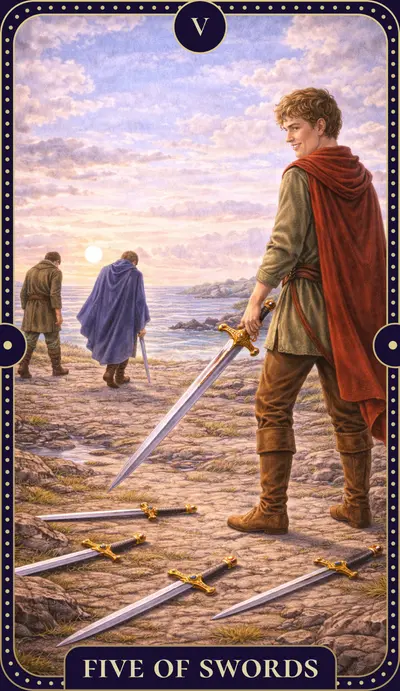
The Five of Swords shows the aftermath of a conflict where one person appears to hold the advantage. The scattered swords ask whether being right has produced a result worth keeping.
This card does not label anyone permanently as a winner or loser. It highlights power dynamics, communication that wounds, and the need to decide which battles align with your values.
- Conflict
- Ego
- Winning at all costs
- Tension
The card’s main theme
Read Five of Swords as a study of conflict where being right can cost trust, belonging, or the purpose everyone was meant to serve. Use the image as a lens for reflection: work with the price of the conflict. A clear boundary and a small experiment will tell you more than a dramatic interpretation. Its value appears in the next honest action, not in a promise about the future.
How this card can appear in life
In a practical reading, Five of Swords often surfaces through a cutting argument, office politics, public humiliation, legal rivalry, or a victory that leaves the room empty. Its constructive side appears through repeated choices, not a single dramatic moment. At work, name the next deliverable; in relationships, make room for mutual response. Work with the price of the conflict, while checking that a rushed interpretation is not disguising exhaustion or fear. The card is most useful when it changes a real conversation, habit, boundary, or decision rather than only your mood. The card earns trust when the price of the conflict remains workable after the first emotion fades.
The person’s inner state
At an inner level, Five of Swords often brings adrenaline and defensiveness after confrontation, followed by the uncomfortable question of what winning cost. When the card is difficult, the challenge is often to stay present without overidentifying with the mood. Ask what is actually happening now, then work with the price of the conflict. Small evidence of safety is more reliable than a sweeping promise when a rushed interpretation is active.
The card’s question
- What does the price of the conflict ask me to stop overlooking?
- How can I honor the price of the conflict without losing myself?
- What evidence would show that I am ready to protect the essential boundary, stop the degrading game, and own your part in the damage?
Interpretation examples
How can Five of Swords help me handle a difficult conversation?
Bring the price of the conflict into the conversation by choosing to protect the essential boundary, stop the degrading game, and own your part in the damage. Leave room for the other person’s response, and do not let retaliating for relief or treating every disagreement as a contest write the whole story.
What relationship pattern does Five of Swords ask me to examine?
Notice how the price of the conflict changes the exchange in ordinary moments. Name what you need directly, especially if retaliating for relief or treating every disagreement as a contest makes silence or overreaction seem easier.
What is one safe experiment suggested by Five of Swords?
Test the idea by choosing to protect the essential boundary, stop the degrading game, and own your part in the damage for a defined period, then check the result against your energy, boundaries, and the behavior of everyone involved.
Upright meaning
The Five of Swords upright points to tension, competition, hollow victory, or a disagreement that leaves a cost behind. Protect your principles, and know when continuing the fight will only deepen damage.
Reversed meaning
The Five of Swords reversed can suggest remorse, reconciliation, unresolved resentment, or withdrawing from a destructive contest. Repair requires accountability rather than pretending nothing happened.
Advice from the Five of Swords
Before responding, decide whether your goal is truth, safety, repair, or simply winning. Keep the boundary that matters and release the argument that only feeds the conflict.
Get a reading in the appFive of Swords Tarot meaning in love and relationships
In love, the card can show arguments, defensiveness, or a pattern where one person must lose for the other to feel secure. Reversed, consider whether an apology and a new boundary can change the pattern.
Five of Swords Tarot meaning in career and finances
For career questions, the Five of Swords warns about office politics, aggressive negotiation, and success that damages trust. Choose clear terms and document agreements instead of escalating every disagreement.
Notable card combinations
- Justice
With Justice, Five of Swords connects the price of the conflict to a concrete choice and a visible next step.
- The Chariot
The Chariot adds a counterpoint: test the price of the conflict against facts, behavior, and the limits of the situation.
- The Devil
Read these cards together as an invitation to let the price of the conflict become a practice rather than a passing mood.
- Strength
Strength brings a different tempo to Five of Swords; let the pairing show what can be changed and what needs patience.
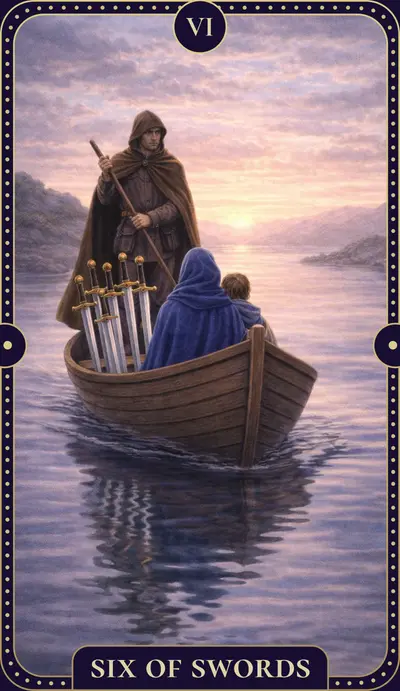
- Six of Swords
This pairing exposes the boundary between the price of the conflict and retaliating for relief or treating every disagreement as a contest.
- The Tower
The Tower keeps the message grounded in ordinary life, where Five of Swords must become a sustainable practice.
Five of Swords Tarot card FAQ
What does the Five of Swords mean in Tarot?
The Five of Swords represents conflict, tension, competition, a hollow victory, and the consequences of hostile communication. It asks what the struggle is costing you.
What does the Five of Swords mean in love?
In love, it can point to arguments, defensiveness, or a power struggle. Reversed, it may show a wish to repair things, but lasting change needs accountability and different behavior.
What does Five of Swords illuminate in this reading?
Read Five of Swords as a study of conflict where being right can cost trust, belonging, or the purpose everyone was meant to serve. This card points to a live pattern, not a fixed verdict; the question and surrounding cards locate it.
How can I use Five of Swords as practical advice?
Work with this card by choosing to protect the essential boundary, stop the degrading game, and own your part in the damage. Keep the decision tied to your actual time, resources, boundaries, and consent.
Does Five of Swords guarantee a particular outcome?
No. Tarot describes patterns, pressures, and possibilities. Your choices, other people’s agency, and changing circumstances still shape what follows.
What is the shadow side of Five of Swords?
The shadow appears when retaliating for relief or treating every disagreement as a contest. Notice the cost without turning it into shame, then return to protect the essential boundary, stop the degrading game, and own your part in the damage as a more honest adjustment.