What the Five of Wands means in Tarot
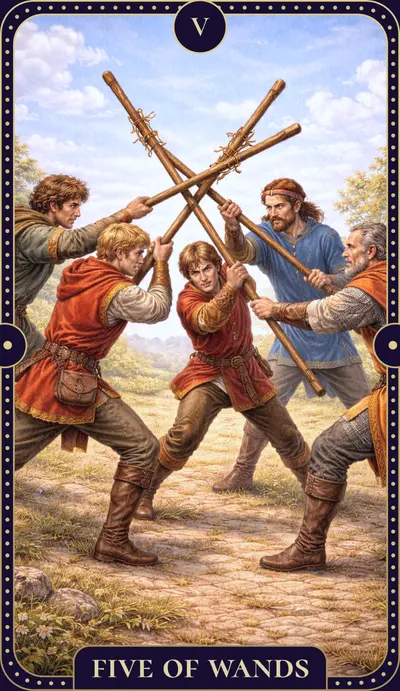
The Five of Wands shows several people crossing staffs in a lively tangle. The image can represent healthy challenge, but it also reveals how quickly uncoordinated energy becomes noise.
The scuffle is not always serious hostility. The card asks whether the disagreement is helping ideas improve, or whether unclear roles and pride are draining everyone involved.
- Competition
- Disagreement
- Rivalry
- Chaos
The card’s main theme
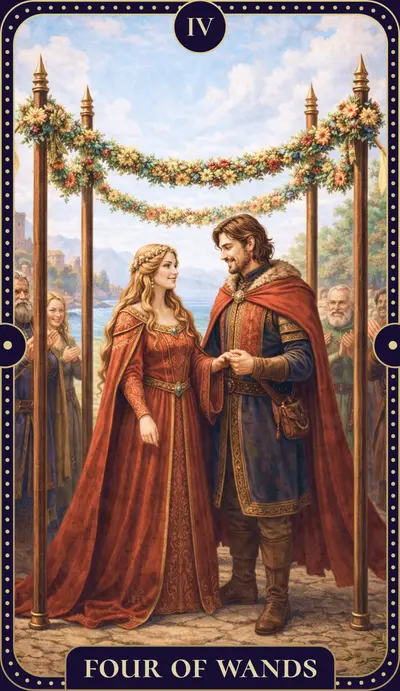
After the settled square of the four, a fifth staff breaks the order and brings friction: many voices, many ideas, and nobody willing to give way yet. Five young men in different colored tunics swing wooden staves at one another on uneven ground, but their movements look more like a game or practice than a real fight. The different colors show clashing perspectives, the chaotic angles of the staves show a lack of coordination, and the playful energy shows that the conflict isn’t necessarily hostile. Is this scuffle training you, or only draining you?
How this card can appear in life
In daily life it looks like a brainstorming session where everyone talks over each other, a competitive job search, sibling rivalry, group chats full of arguments, team sports or an office where everyone wants credit. It favors healthy competition, debate and training. It warns against conflict for its own sake. Its shadow is constant bickering that wastes energy.
The person’s inner state
Irritation buzzes under the skin. You want to be heard, but so does everyone else. There may be excitement in the challenge too. The playful movement of the figures suggests that you can compete without making an enemy.
The card’s question
- Which argument in your life is more about being right than about solving something?
- Where could competition sharpen your skills instead of draining you?
- What would happen if you put your staff down for a moment and listened?
Interpretation examples
A competitive job search
Upright, it shows many strong candidates and a need to stand out clearly. Reversed, it suggests the competition is easing or that you’ve found a niche with fewer rivals.
A noisy family group chat
It describes arguments, conflicting opinions and a lot of heat without much result. Reversed, it shows the tension calming down as people agree to disagree.
A pickup basketball league
Upright, the trash talk and hard fouls are part of the fun and make everyone sharper. Reversed, a grudge between two players starts to wreck the games.
Upright meaning
Upright, five crossed staffs mean competition, debate, creative friction, and many people pushing in different directions. Establish the shared goal and let disagreement produce useful refinement.
Reversed meaning
In reverse, the card can indicate avoidance, hidden resentment, reduced tension, or conflict that is becoming exhausting. Address the real issue instead of keeping peace through silence.
Advice
Separate the shared goal from the clash of egos. Invite the strongest useful idea, define the rules of engagement, and stop investing in friction that produces no learning.
Get a reading in the appIn love and relationships
In love this card brings rivalry and arguments: disagreements, competing needs, rivals for someone’s attention, clashing temperaments. In a new connection the same energy can look like playful teasing and chemistry. Notice whether the tension encourages honest growth or reflects unresolved resentment, and try turning the conflict into a conversation rather than a contest. Reversed, it shows avoiding quarrels, fatigue from constant struggle, or reconciliation.
Career and finances
Professionally, this means competition, brainstorming, a tough market and arguments in the team. Friction can move a project forward if there are rules of the game, so stand out through skill and stay out of office politics. When reversed, it points to chaos, people not listening to each other, or a conflict dying down.
As the card of the day
Today may be noisy: debates, rivalry, everyone talking at once, without real hostility. Competition can sharpen ideas as long as it doesn't get personal.
Sign of the dayA lively debate where everyone wants to talk, and a chance to put your idea forward.
- Love
- Small arguments and disagreements are possible. Let them help you understand each other, not crown a winner.
- Work
- Debates about approach are useful today. Stand your ground, but listen to others.
- Money
- Compare offers and negotiate; it's fitting today. Keep money disputes free of emotion.
How would you act in today's disagreement if the goal were the best solution rather than winning?
Notable card combinations
- The Chariot
You win by focusing your energy in one direction.
- Seven of Wands
Defending your position against challengers.
- Three of Pentacles
Different opinions come together into a shared result.
- Temperance
Mediation and compromise calm the conflict.
- Ten of Swords
A conflict goes too far and causes lasting damage.
- Queen of Cups
Empathy helps resolve disagreements.
FAQ
What does the Five of Wands mean in Tarot?
Competition, debate, clashing priorities, creative friction, and energetic disagreement. The card asks whether the conflict can be organized into constructive progress.
Is the Five of Wands a yes or no card?
Unclear for now: the staves are still swinging, and the winner hasn’t been decided. Reversed, it tilts toward “likely yes,” because the conflict is easing and agreement becomes possible.
What does the Five of Wands reversed mean?
Usually the scuffle winds down: conflicts get resolved, people find common ground or simply avoid confrontation. Sometimes, though, the tension is only going underground.
Is the Five of Wands a bad card?
Not necessarily. Waite called the scene “mimic warfare,” and the staves swing more like a sport than a battle. It turns heavy when the argument stops producing anything: the same quarrel every week, or a team where nobody listens.
How is the Five of Wands different from the Five of Swords?
Among the wands nobody is hurt and nobody has won yet; the staves cross in what looks like practice. The Five of Swords shows the aftermath of a fight, one man gathering swords while the others walk away beaten. The fire card describes rivalry that can sharpen everyone, the air card a victory that costs the relationship.