What Justice means in Tarot
Justice is the eleventh card in the Rider–Waite Major Arcana and represents balance, facts, and responsibility for a choice. The sword and scales ask you to pair a clear decision with an honest assessment of the circumstances.
The card does not promise a comfortable outcome. It asks you to name the facts, review agreements, and see how previous actions are shaping the situation now.
- Justice
- Truth
- Accountability
- Fairness
The card’s main theme
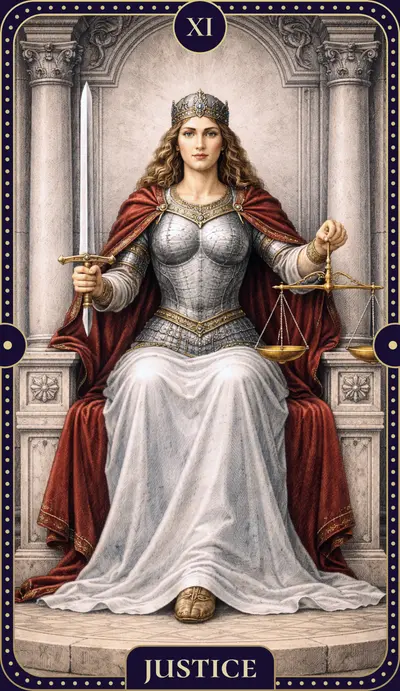
Card XI deals with consequences that follow actions with clear logic: what was set in motion comes back to you in its true proportions. Framed by two gray columns and a purple veil, a crowned figure in red holds the balance in the left hand and raises a straight, two-edged blade in the right; the tip of a white shoe shows beneath the hem. The sword cuts through excuses, the scales weigh facts rather than feelings, and the white shoe suggests readiness to step forward and act on the verdict. The card asks you to look at the situation as if you were the judge and not the defendant.
How this card can appear in life
Tax season, a court summons, a signature on a lease, an honest confession about who broke the vase: this is where the card with the scales feels at home. It favors lawyers, judges, accountants, auditors and mediators. Between partners it asks for an honest split of chores, money and blame. Its shadow is cold judgment that forgets mercy.
The person’s inner state
Your thinking turns sober and exact. You want the truth even if it’s uncomfortable, and you’re ready to own your part. Emotions stay in the background. The double-edged sword suggests that fairness applies to you as much as to anyone else.
The card’s question
- If you were weighing this situation for someone else, what would you tell them?
- If the scales were weighing only your side, what would they show?
- Where are you asking for fairness while quietly keeping the scales tipped toward you?
Interpretation examples
Taking a landlord to small claims court over a deposit
Upright, it favors a fair verdict if your documents and facts are solid. Reversed, the hearing may drag on, or your paperwork has a gap you would rather not think about.
Dividing property after a divorce
It describes a fair split and agreements that hold up. Reversed, it shows one side hiding assets or pushing for more than their share.
Admitting a mistake at work
Upright, it supports honesty and suggests the consequences will be manageable. Reversed, it warns that covering things up will make the fallout bigger.
Upright meaning
Upright, the sword and scales support objectivity, honest negotiations, documents, and decisions made with consequences in mind. Act transparently and account for real obligations as well as personal wants.
Reversed meaning
In the reversed position the scales tilt, which can point to bias, avoidance of responsibility, imbalance, or unclear terms. Check the information carefully and do not build a conclusion on resentment or assumption.
Advice
Write down the facts, record the agreements, and name the likely consequence of each option. Choose the decision you can explain without distorting reality.
Explore a related Tarot spread Get a reading in the appIn love and relationships
In love, the card means honesty, responsibility, and equal footing: agreements, a discussion of obligations, sometimes legal matters such as marriage, divorce, or dividing property. In a couple, nobody keeps a secret ledger, and chores, money, and apologies are split honestly. The card supports a direct conversation without manipulation and can point to a decision about the relationship made with a clear head. When reversed, it points to dishonesty, avoided responsibility, or a biased view of a conflict.
Career and finances
In your working life, the card is linked to contracts, evaluations, employment and legal matters, and an honest assessment of results. Check documents and terms before signing. Reversed, it shows distorted facts, unfair evaluation, or broken agreements; gather evidence.
As the card of the day
Justice is a reminder that actions have consequences and that good decisions rest on facts. Contracts, disputes, and questions of who owes what can get settled today if you approach them honestly.
Sign of the dayThe tell: the honest answer turns out simpler and better than the convenient half-truth.
- Love
- Balance matters: who's giving what to the relationship. Talk about it calmly, without keeping score of old hurts.
- Work
- Contracts, legal questions, and disputes move forward on documents, not verbal promises.
- Money
- Pay back what you owe and check your statements. Clean accounts now save trouble later.
Which decision could you comfortably explain to a fair, neutral person?
Notable card combinations
- The Emperor
Official decisions, laws and authority applied fairly.
- Two of Cups
A balanced relationship with equal give and take.
- Ten of Swords
Old choices send in their bill.
- Seven of Swords
Dishonesty comes to light.
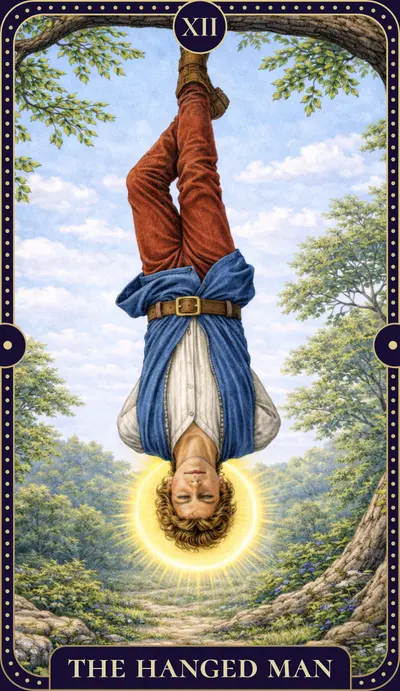
- The Hanged Man
A decision is postponed, and waiting is part of the process.
- Page of Pentacles
Legal or financial paperwork arrives.
FAQ
What does Justice mean in Tarot?
Balance, truth, evidence, and responsibility for decisions. The card encourages you to consider causes and consequences rather than only the result you want.
Is Justice card 8 or 11 in Tarot?
In the Rider–Waite system it is usually card 11, and Strength is card 8. Some traditions reverse the numbering of these two Major Arcana cards.
Is Justice a yes or no card?
Yes, if the truth is on your side: the blade cuts cleanly for someone with clean hands and a balanced account. Reversed, it leans “likely no,” because the terms are uneven or someone isn’t being honest.
Is card XI favorable in a lawsuit or legal dispute?
Yes, if you are in the right and your paperwork is in order. It shows a fair decision, a contract signed on equal terms or a dispute resolved on the facts.
What does Justice reversed mean?
Upside down, the scales tip: a biased process, a lie that goes unchecked or someone slipping out of the consequences. It can describe a legal setback or a situation where someone refuses to own their part.
How is Justice different from Judgement?
Both cards deal with evaluation, but at different scales. Card XI weighs specific actions against facts and rules: a contract, a dispute, a decision and what follows from it. Card XX sums up a whole chapter of life, as the angel’s trumpet sounds and people rise from their coffins to answer an inner call. When the question is who is right in a dispute, the scales apply; when it is time to rethink the past and step out of it, the trumpet does.
What kind of person does the figure with the sword and scales describe?
Someone who decides on the facts: a lawyer, judge, accountant, auditor or mediator, or the person in a dispute who sticks to the rules and doesn’t take sides in advance. They are honest and consistent, though they can come across as cold. Reversed, this is a biased or vindictive person who passes verdicts faster than they look into things.